
Executives from Boston Dynamics, Hyundai Mobis, Hyundai Wia say industrial deployments — not demos — define real competitiveness
LAS VEGAS — As robotics takes center stage at the CES 2026 tech trade show in Las Vegas, Hyundai Motor Group is positioning itself as a leader in deploying humanoid robots for real industrial work, drawing a clear contrast from Chinese rivals emphasizing cost efficiency and visual demonstrations.
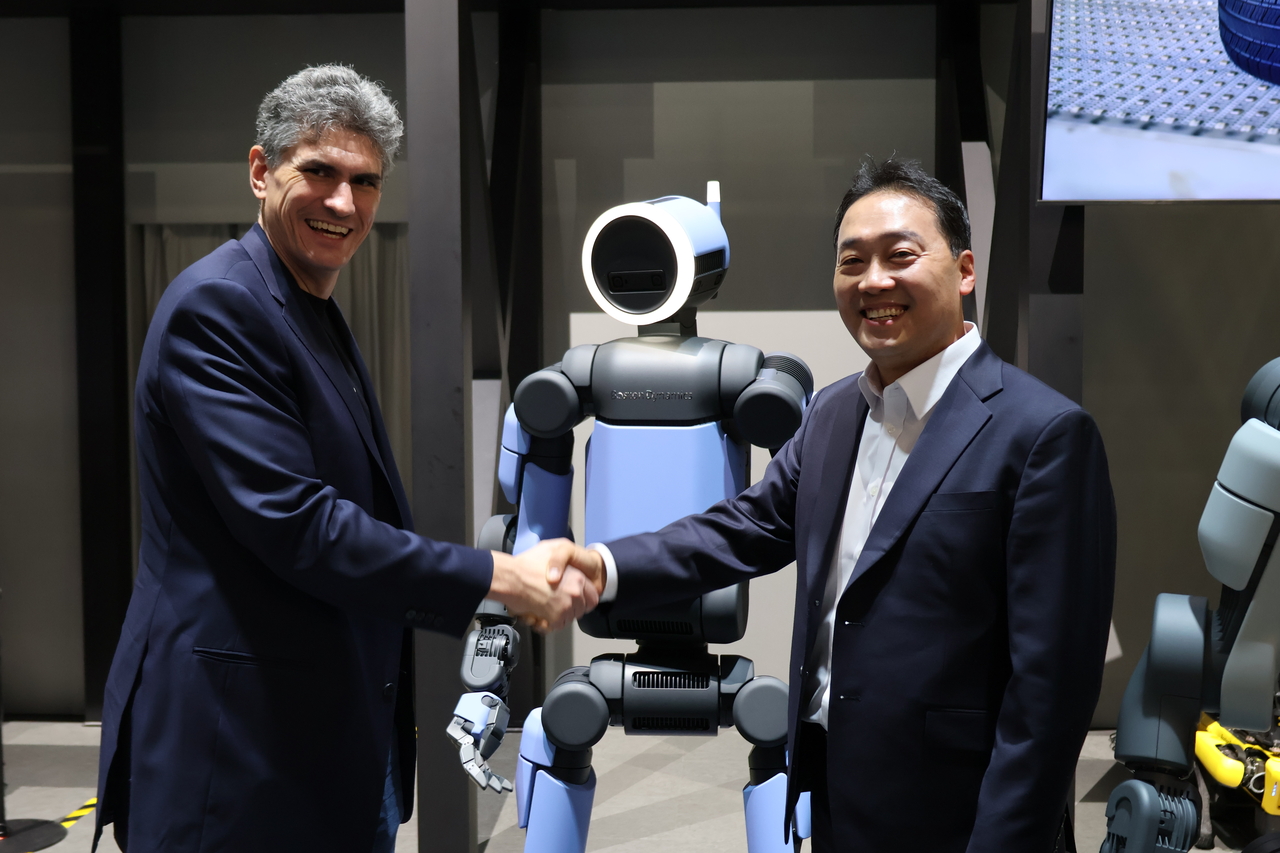
That message emerged from a group interview Wednesday with executives from Hyundai’s US-based Boston Dynamics, which unveiled its next-generation Atlas humanoid robot at the show, and the automaker’s parts affiliates Hyundai Mobis and Hyundai Wia. Executives said Hyundai’s competitive edge lies not in spectacle, but in whether humanoid robots can perform economically viable tasks on factory floors.
While acknowledging Chinese competitors’ rapid push into the global humanoid robot market, Zachary Jackowski, head of Atlas development at Boston Dynamics said during a group interview on Wednesday that “the real focus should be on whether robots can perform meaningful work in real industrial settings. Robots that simply walk around a site or demonstrate martial arts moves do not have economic value.”
“Chinese robots tend to focus on mimicking human motion,” said Oh Se-wook, executive director of steering and suspension research and development at Hyundai Mobis, drawing a clear distinction from Hyundai’s approach, which he said is designed to outperform human workers on factory lines.
One of its robot’s key features is Hyundai Mobis’ advanced actuators, which enable the Atlas humanoid to move humanlike smoothly and naturally — allowing it to maintain balance and perform tasks with the precision and safety required to replace labor-intensive work.
Actuators represent Hyundai Mobis’ first step into robotics, building on its expertise in core automotive parts. With Boston Dynamics as its first actuator customer, the partnership is set to expand into humanoid joint systems. The company is also planning to enter the gripper and end-effector businesses — essential robotics components that determine whether robots can be viably deployed on factory floors.
In line with Hyundai Motor Group’s plan to deploy Atlas humanoids at its plant in Savannah, Georgia, by 2028, Hyundai Mobis is reviewing local actuator production near the facility. Ahead of mass production, the company will establish a prototype line at its Uiwang R&D center in Gyeonggi Province in the first half of this year to supply prototypes to Boston Dynamics.
Against the backdrop of fierce cost competition from leading Chinese logistics robotics companies such as Hikrobot and Geek+ on cost efficiency, Baek Ik-jin, vice president of mobility solution division at Hyundai Wia, said the company’s strength lies in highly customized robotics solutions.
Hyundai Wia’s three modular robots, unveiled at CES, feature interchangeable hardware and software architectures designed for reconfiguration to meet diverse customer demands. The lineup includes an autonomous mobile robot capable of carrying up to 1.5 tons, a collaborative robot with a 15-kilogram payload and a parking robot that can move vehicles weighing up to 3.4 tons.
About 450 logistics robots are already operating across sites at Hyundai Motor, Hyundai Wia and Hyundai Mobis, alongside some 45 parking robots.
In these production facilities, parking robots have improved space efficiency by about 27 percent, while logistics automation has typically lifted productivity by around 20 percent. At Hyundai Motor Group Metaplant America in Georgia, 290 logistics robots are in operation, significantly raising automation levels.
The company plans to complete fully unstaffed logistics automation by 2028, starting with a pilot deployment at its Changwon plant in South Gyeongsang Province, where investment is already underway. The system is expected to significantly lift Hyundai Motor Group’s operational efficiency.